


Real estate in Brazil from a German perspective
Brazil – the land of samba rhythms, endless beaches, and emerging economic centers. But how attractive is it really in 2025 to invest in property there? German investors are asking: Is it worth it? In this article, we’ll explore the opportunities and challenges of investing in real estate in Brazil from a German perspective. You’ll receive clear pros and cons, learn what to watch out for, and get actionable recommendations to help you make an informed decision.
Why More Investors Are Looking to Brazil
High Growth Rates
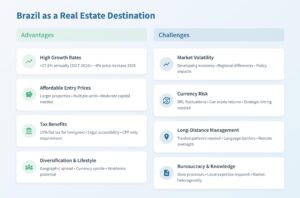
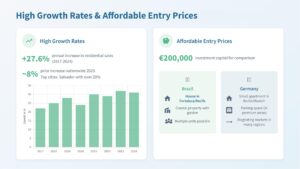
The Brazilian real estate market is showing strong growth. From 2017 to 2024, residential sales rose by an average of +27.6% per year – a clear indicator of vibrant demand. Prices have increased in many cities, with 2025 seeing particularly strong growth: about +8% nationwide, and more than +20% in top cities like Salvador. This kind of expansion suggests real upside potential, unlike stagnating markets in Europe.
Affordable Entry Prices
Despite this growth, Brazilian property is still relatively inexpensive on the global stage. A house in a coastal city like Fortaleza or Recife may cost the same as a small apartment in Berlin or Munich. This lower purchasing power parity allows German investors to:
-
Acquire larger properties
-
Buy multiple units and diversify internally
-
Enter the market with moderate capital
Tax Benefits and Legal Accessibility
Brazil treats foreign property buyers favorably. Foreigners can acquire full ownership of urban real estate (with some restrictions on rural or border zones). All you need is a CPF (Brazilian tax ID).
Moreover, Brazil offers tax perks for foreign investors:
-
15% flat income tax on rental income (locals pay up to 27.5%)
-
Capital gains tax between 15%–22.5%
-
Tax-free repatriation of the original capital investment when selling
These advantages often lead to higher net returns compared to European markets. The legal system also provides decent ownership protection through a transparent property registry, with rights for foreigners equal to those of Brazilians.
Portfolio Diversification and Currency Upside
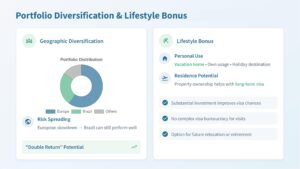
For investors already deeply exposed to the European market, Brazil offers an opportunity to diversify geographically. If the European economy slows down, a thriving Latin American market could still perform well.
Additionally, the exchange rate can boost profits. If you invest when the euro is strong and the Brazilian real (BRL) is weak, and sell later when the BRL strengthens, your return can be amplified by the currency shift. Some investors even plan with this “double return” potential.
Lifestyle Bonus & Residence Potential
Buying real estate in Brazil can serve personal purposes too – as a vacation home or long-term residence. Substantial investments may also facilitate long-term visas. Brazil doesn’t have a formal Golden Visa, but real estate ownership can improve your chances of obtaining residency or extended stays, especially for retirees or entrepreneurs.
The Challenges You Should Consider
Every opportunity comes with risk. Here are key challenges German investors should be aware of:
1. Market Volatility
Brazil is a developing economy. Its real estate market can be more volatile than Germany’s. After a growth phase, a local downturn or policy shift can impact demand and prices. For example, after the 2014 World Cup and 2016 Olympics, some urban markets like Rio saw price stagnation or declines.
A booming neighborhood can lose momentum if infrastructure stalls or public safety declines. Brazil’s regional markets are diverse, so risk varies by location.
2. Currency Risk
The Brazilian real (BRL) can fluctuate sharply. A weakening BRL can erode your returns in euro terms. Example: You buy a property in 2025 when 1 € = 6 R$, and sell in 2029 when 1 € = 8 R$ — you may lose money, even if the property value rose locally. On the other hand, the opposite movement can significantly boost returns.
This currency volatility must be considered. You can mitigate the risk by:
-
Holding your investment long-term
-
Reinvesting locally in BRL
-
Monitoring exchange rate trends and acting strategically

Local Market Knowledge
Brazil’s real estate landscape is extremely heterogeneous. Prices, regulations, and safety levels vary greatly even within the same city.
What looks like a bargain may be:
-
Located in a risky area
-
Poorly built or not fully registered
-
Lacking infrastructure or future demand
Without on-the-ground knowledge, it’s easy to misjudge a property’s true value. That’s why it’s essential to work with reputable agents and legal advisors who know the local market.
Tips for Doing It Right
If you’re considering buying in Brazil, here’s how to approach it intelligently:
✅ Define your goals:
-
Pure investment (rental income, capital gains)?
-
Personal use? (vacation home, partial residence?)
Your strategy will depend on your answer.
✅ Focus your research:
Don’t browse all of Brazil. Choose 1–2 cities or regions and deep dive. Look at:
-
Population growth
-
Employment trends
-
Infrastructure projects
-
Tourism flow
✅ Visit before buying:
A scouting trip is essential. Walk through neighborhoods, talk to residents and realtors, visit during different times of day. Stay a few nights in the area. Trust your instincts. Is it safe? Well-maintained? Vibrant?
✅ Build a local team:
-
Real estate agent: ideally bilingual and familiar with foreign clients
-
Lawyer: verifies ownership, registers transaction
-
Property manager: for rentals, maintenance, tenant issues
Their fees are worth the peace of mind. Expect to pay around 8–10% of rent for ongoing management.
✅ Plan your financing:
Most foreigners buy with cash. Brazilian banks rarely lend to non-residents. Some developers offer installment plans on new-builds. Always have a cash buffer for maintenance and emergencies.
✅ Know your tax obligations:
Brazil has a 15% withholding tax on rental income for non-residents. Thanks to a tax treaty, this is credited against your German tax bill, so you won’t be taxed twice. Still, consult a German tax advisor to plan optimally.
✅ Diversify:
Don’t put everything into one high-risk project. Start with one apartment in an established area. Once you understand how the market and management works, you can scale.
Conclusion: Is It Worth It?
So… is it worth it for German investors to buy real estate in Brazil?
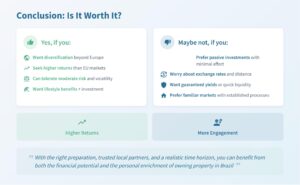
✅ Yes, if you:
-
Want to diversify internationally
-
Are looking for higher returns than in the EU
-
Can tolerate moderate risk
-
Want to combine lifestyle and investment
❌ Maybe not, if you:
-
Prefer fully passive investments
-
Worry about exchange rates or travel distance
-
Want guaranteed yields or quick resale liquidity
Ultimately, it comes down to your investment personality. If you’re globally minded, willing to learn, and open to new cultures, Brazil offers exciting real estate opportunities.
With the right preparation, trusted local partners, and a realistic time horizon, you can benefit from both the financial potential and the personal enrichment of owning property in Brazil.
Boa sorte! – Good luck!